Summary
The PR review queue is the most common friction point between team members. When PRs stall behind reviewer availability, developer momentum and delivery velocity both suffer.
Faros AI's 2025 research found that PR review time increases 91% in teams with high AI adoption. AI accelerates code generation; the review queue becomes the team bottleneck.
AI-powered code review tools address collaboration friction at its source: reviewer-dependent delays, standards that vary by who happens to be available, and the overnight wait in cross-timezone workflows.
The meaningful change is not speed. It is equity: the same standards, the same feedback quality, and the same turnaround on every PR regardless of who submitted it or when.
What are AI-powered code review tools?
AI-powered code review tools analyze code changes in a pull request for bugs, security vulnerabilities, quality issues, and standards violations, providing feedback without requiring a human reviewer to initiate the process. They operate as part of the pull request workflow, delivering first-pass review the moment code is submitted. The more capable implementations apply validated fixes directly on the branch, enabling teams to maintain consistent review standards across all contributors, time zones, and code volume levels.
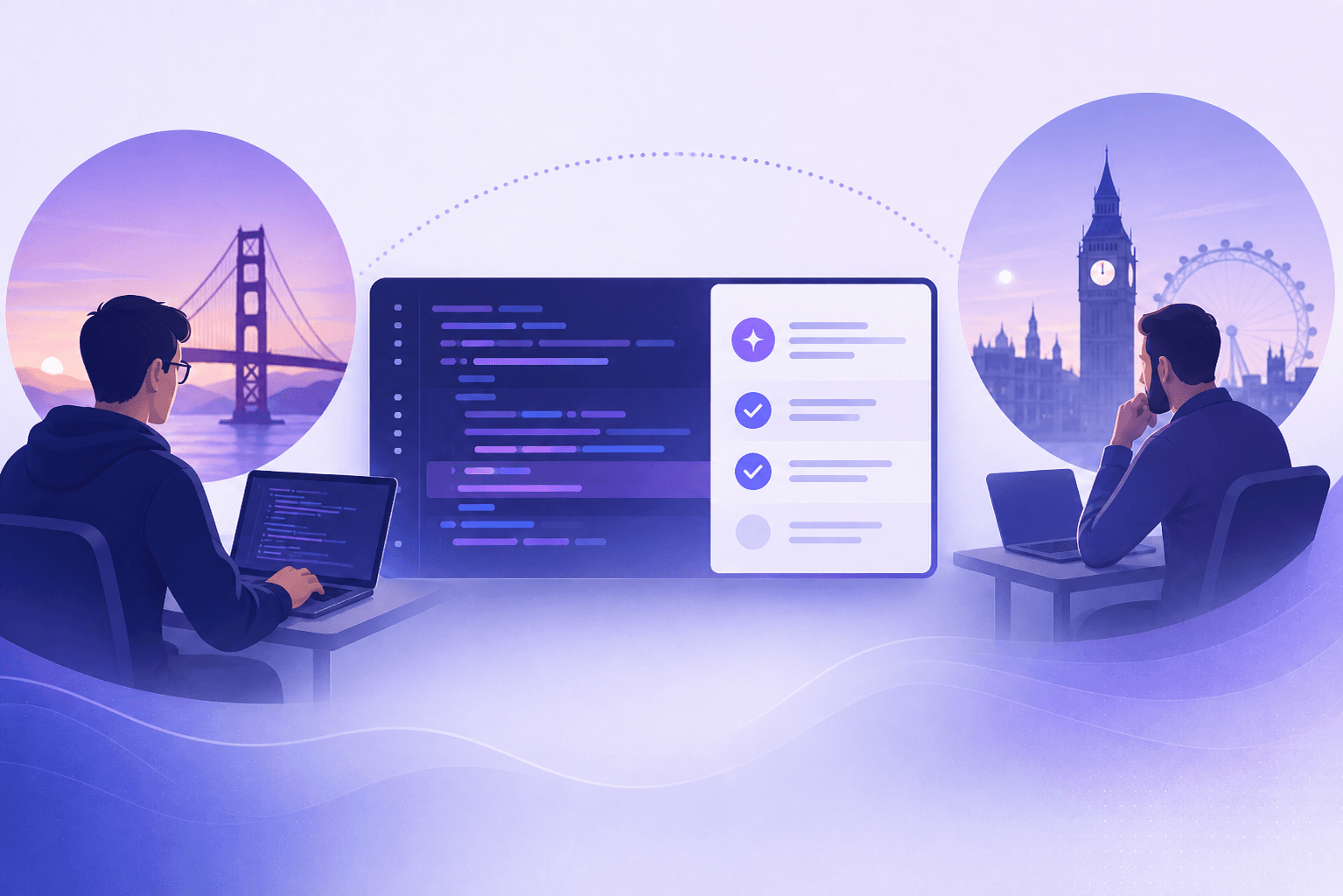
Picture a developer on the West Coast who submits a PR at 5 PM on a Tuesday. A reviewer in London picks it up the following morning. The developer has spent the intervening hours on something else, lost the thread on the original change, and now has to rebuild context to address the feedback. The PR has been sitting idle for fourteen hours. That pattern, multiplied across a distributed team with a high PR volume, is not a time zone problem. It is a structural problem with how review capacity is organized.
AI-powered code review tools improve team collaboration by removing the conditions that create that friction. Not by making individual developers faster, but by making the process less dependent on any single reviewer's availability at any given moment.
Where code review creates team friction
Reviewer dependency
Code review as a practice is valuable. Code review as it is commonly structured, where a PR cannot progress until a specific senior engineer reads it, is a single point of failure. When that engineer is unavailable, the PR waits, the developer context-switches, and the merge queue grows. Faros AI's 2025 research found that PR review time increases 91% in teams with high AI adoption. The bottleneck is not developer productivity. It is review capacity.
Time zone gaps and inconsistent standards
For distributed teams, reviewer dependency becomes a time zone problem. A PR submitted at the end of one team's working day may not receive its first comment until a reviewer in another region comes online hours later. When the review arrives, re-engaging with the original change costs time on both sides.
The inconsistency problem compounds this. Different reviewers apply different thresholds: one focuses on performance, another flags security patterns the first missed, a third prioritizes formatting. For junior developers learning team conventions, or for AI-generated code that needs consistent evaluation, this variability creates confusion about what good looks like on this team.
How AI code review changes the collaboration dynamic
Dimension | Manual-only review | AI-augmented review |
Time to first feedback | Hours to days, reviewer-dependent | Immediate on PR submission |
Time zone coverage | Limited to reviewer working hours | 24/7 |
Standards consistency | Varies by reviewer | Uniform across all contributors |
Junior developer feedback | When senior engineer has bandwidth | On every PR |
Human reviewer focus | Mechanical checks and design, mixed | Design and architecture |
Multi-repo oversight | Bottlenecked by reviewer count | Scales horizontally |
When AI review tools provide automated first-pass coverage at PR submission, the developer who opens a PR gets structured feedback immediately while still inside the problem. By the time a senior engineer opens the PR, the mechanical issues have been identified and, in capable implementations, already resolved. Human review focuses on architecture, design choices, and judgment-intensive questions that require it.
The consistency effect matters at least as much as the speed effect. AI review enforces the same code standards on every PR regardless of who submitted it or who is available. The same code security checks, formatting rules, and quality thresholds apply to a senior engineer's change, a junior developer's first PR, and AI-generated code alike. For open source projects and fast-scaling organizations, that consistency makes review equitable and manageable at scale.
Beyond the PR: CI failures and multi-repo visibility
Code review is one collaboration point. CI/CD pipeline failures are another, and typically more opaque. When a build breaks in a distributed team, identifying which change caused it and who has the context to fix it requires coordination that pulls developers out of focused work. AI-powered failure analysis answers those questions without the Slack threads and handoffs. The team sees a resolved pipeline with an explanation, not an investigation in progress.
For tech leads managing PRs across multiple repositories, context-switching overhead makes consistent oversight unsustainable at scale. Auto-generated PR descriptions, updated as code changes and linked to relevant tickets, compress the context-rebuilding time that makes multi-repo management difficult. The review starts from an informed position rather than a cold read of an unfamiliar diff.
Gitar: built for teams where review is the delivery constraint
AI review earns its place in team collaboration by ensuring the human conversation starts from a cleaner, better-prepared state.
With Gitar, every PR gets a single living overview comment, updated as code changes and never duplicated. Inline fixes are applied directly to the branch, validated against CI, removing the round-trip between reviewer comment and developer action.
XFactor.io's head of technology found Gitar's feedback "especially useful for managing PRs across dozens of repositories," citing high relevance and low noise as the properties that make multi-repo oversight workable. OpenMetadata's CTO described the reviews as "consistently actionable and relevant, not generic bot feedback." Accuracy of output is what sustains adoption: teams whose developers trust what they see are the ones where the collaboration benefits compound.
Frequently asked questions
How do AI code review tools improve team collaboration?
By removing the conditions that create friction: reviewer-dependent delays, time zone bottlenecks, and inconsistent standards. Automated first-pass coverage means PRs advance without waiting for a specific reviewer. Senior engineers spend review time on architectural judgment. The result is faster cycles, more equitable review distribution, and less coordination overhead.
Can AI replace human code reviewers?
AI can handle the substantial majority of code review, with human reviewers handling the exceptions: architecture decisions, security-critical logic, and changes where the stakes warrant explicit sign-off.
How does AI help distributed teams?
By providing review coverage that eliminates the overnight wait in cross-timezone workflows. A PR submitted at the end of one team's day receives automated first-pass review immediately. The review cycle that previously spanned two working days collapses into hours.
What role does AI play in CI/CD workflows for team collaboration?
AI adds shared visibility and automated resolution to the CI failure loop. Rather than a broken build requiring coordination to identify the responsible change, CI/CD automation identifies the root cause, classifies it as code-introduced or infrastructure noise, and applies a fix where applicable.
Are AI code review tools suitable for large teams?
They perform best in large teams, where reviewer bottlenecks scale worst with manual-only approaches. AI review scales horizontally: adding repositories and contributors does not increase the review burden on senior engineers, because the mechanical first pass is handled before they open the PR.