
Latest videos
Complex Workflows in Natural Language
No scripts, no YAML. Just prompts. Try for free at https://gitar.ai

Gitar - Faster Review Cycles
Handles feedback automatically. Merge faster. Try for free at https://gitar.ai

Gitar - CI Heals Itself
Fixes build, test and other failures automatically. Stay focused. Try for free at https://gitar.ai
Gitar - Understand Failures Instantly
No digging through logs. Just the root cause. Try for free at https://gitar.ai

Introducing Gitar - CI for the Age of AI
Gitar lets you define pipelines as prompts, analyzes and fixes broken builds, and addresses code review feedback on your PRs. Merge more, faster with Gitar. Try for free at https://gitar.ai
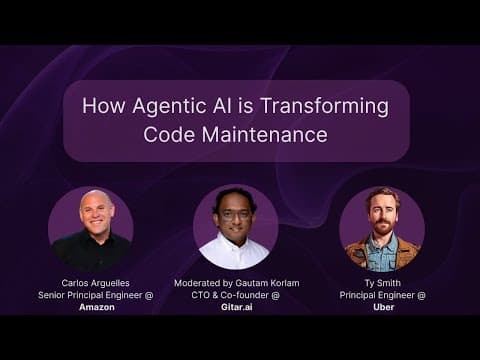
How Agentic AI Is Transforming Code Maintenance
Summary This webinar explored the practical impact of Agentic AI on developer productivity, testing, and code maintenance at scale. Moderated by Gautam, the discussion featured insights from Ty Smith, an engineering leader at Uber, and Carlos, a Senior Principal Engineer at Amazon. Together, they examined real-world implementation of AI-assisted development tools, challenges in evaluating and adopting these technologies, and how roles and workflows are evolving in response. Relevant Resources Gitar.ai: https://gitar.ai/ Connect with Ty: https://tysmith.me/ Connect with Carlos: https://www.linkedin.com/in/carlos-arguelles-6352392/ Key Takeaways 1. AI at Scale: Uber’s “Auto Migrate” uses Agentic AI to convert millions of lines of Java to Kotlin—blending deterministic tools, LLMs, and multi-stage verification. 2. LLMs for Testing: At Amazon, natural language tests powered by LLMs outperform traditional frameworks in flexibility and bug discovery, but require strong guardrails. 3. Tool Overload: The rapid evolution of AI dev tools demands nimble evaluation strategies—prioritizing flexibility, optionality, and human-in-the-loop feedback. 4. Measuring ROI: ROI is multi-dimensional—factoring in test creation speed, flakiness, maintenance cost, and “dev years saved,” not just lines of code. 5. Changing Roles: Developers are shifting from coding to orchestrating agent workflows, requiring new team structures and cross-functional thinking. 6. MCP & Governance: Model-Component Protocols (MCPs) are powerful but bring security, auth, and governance challenges that must evolve alongside usage. 7. Experiment with all the AI tools you can get your hands on. Key Timestamps 00:00 – Intro to panelists and topic: Agentic AI & developer productivity 2:11 – Context on challenges post-code-generation (maintenance, security) 5:01 – Uber’s Auto Migrate project: centralizing code transformation 10:23 – Amazon’s use of LLMs for natural language-based test execution 15:17 – Evaluating AI tools, trust issues, and cultural blockers 23:09 – ROI frameworks and balancing dev time vs. hardware cost 27:04 – Changing job roles and future of developer archetypes 34:50 – Code quality and ownership in the age of AI generation 39:57 – Flaky tests and LLM creativity: managing guardrails 46:08 – Scaling AI agents: context size, modularity, and multi-agent systems 51:14 – MCP governance, authentication, and agent policy design 54:03 – Injecting expert agents for accessibility, image quality, etc. 57:00 – Final thoughts and advice for developers navigating the AI shift #AI #AgenticAI #SoftwareEngineering #DeveloperProductivity #CodeMaintenance #Gitar #UberTech #AmazonTech #AIInfrastructure #DevTools #MCP